Institutional Insight Paper
Risk-Sharing or Risk-Transfer: The Structural Choice in Non-Interest Project Finance
How Sharia-compliant structures change project risk allocation, and when that change favours the operator
Executive Summary
Beyond Zero Interest
Non-interest project finance in Nigeria has grown into a $4 billion market segment, anchored by sovereign Sukuk issuances totalling ₦2.205 trillion in cumulative subscriptions since 2017 and a non-interest capital market that crossed ₦1.6 trillion in size by late 2025. Yet most Nigerian operators considering this financing channel evaluate it on a single dimension: the absence of an interest rate.
The structural choice between conventional and Sharia-compliant project finance is not about price or doctrine; it is about how project risk is allocated between the operator and the financier, and at what cost.
A conventional loan transfers all asset and operational risk to the borrower, who must repay regardless of how the financed asset performs. Most non-interest structures redistribute this allocation. This paper sets out how the principal Sharia-compliant structures work in practice, the risk reallocations they effect, and the categories of Nigerian real-sector projects for which the reallocation creates genuine economic advantage.
Methodology and Scope
The analysis draws on Coinletter's review of non-interest financing structures used in Nigerian real-sector projects, supplemented by public data from the Securities and Exchange Commission, the Debt Management Office, the Central Bank of Nigeria, Fitch Ratings sector commentary, and industry reporting on the Islamic finance market through 2025 and early 2026.
It examines the four principal Sharia-compliant structures used in Nigerian project finance: Murabaha, Ijara, Istisna, and Musharakah. It does not cover Takaful (Islamic insurance) or the secondary-market dynamics of sovereign Sukuk, which sit outside the project finance context.
Conclusions apply most directly to medium-scale and large real-sector projects in manufacturing, infrastructure, agribusiness, and real estate, where the choice between conventional and non-interest structuring is commercially open. Religious-compliance considerations are noted where they intersect with structural design but are not the analytical lens of this paper.
I. Beyond the Rate: What Non-Interest Financing Actually Is
The Nigerian operator who first encounters non-interest financing typically does so through one of three doors: an Islamic bank's term-finance product, a sovereign Sukuk subscription opportunity, or a development finance institution's non-interest window. In each case, the immediate impression is that non-interest financing is conventional financing with a different label and without the interest charge. This impression is wrong, and it is the source of most of the structural misunderstandings that follow.
Sharia-compliant project finance is not a parallel system that prices money differently. It is a structurally different category of finance that does not, at its core, lend money at all. The Sharia prohibition on riba is not a prohibition on financiers earning a return; it is a prohibition on earning a return that is decoupled from the underlying real economic activity. The structural consequence is that every non-interest financing structure is anchored to a specific asset, transaction, or commercial relationship, and the financier's return is generated from that underlying economic reality rather than from the time value of borrowed money.
This single principle has substantial implications. Consider the structural difference:
- Conventional loan: The lender advances money to the borrower; the borrower buys the plant; the borrower repays the lender regardless of whether the plant operates as planned. The lender's return is interest; the lender's risk is borrower credit risk.
- Murabaha: The financier itself buys the plant from the supplier and then sells it to the operator at a marked-up price, payable over time.
- Ijara: The financier buys the plant and leases it to the operator, earning a rental stream. Risk includes operator lease default and asset residual value.
- Musharakah: The financier and the operator together capitalise the project and share in its profits and losses in a defined proportion.
These structures are forms of financing in which the financier is not a creditor with a fixed monetary claim. The financier is a temporary owner, a lessor, a partner, or a constructor, whose return is tied to the real economic reality of the asset.
II. The Four Workhorse Structures
For Nigerian real-sector projects, four Sharia-compliant structures account for the substantial majority of non-interest financing arrangements.
1. Murabaha (Cost-Plus Sale)
The financier purchases an asset on behalf of the operator and immediately resells it to her at a price that includes a disclosed profit margin, payable in instalments over an agreed period. Murabaha is the workhorse of Sharia-compliant asset finance in Nigeria: vehicles, equipment, inventory, and other defined-asset purchases are commonly financed this way.
2. Ijara (Lease Asset)
The financier buys the asset and leases it to the operator for a defined term, with rental payments that may be fixed or variable. At the end of the term, the operator typically has the option to acquire the asset outright. Ijara is used widely for capital-equipment finance, real-estate finance, and project finance involving large, identifiable assets.
3. Istisna (Construction Finance)
The financier commissions the building of an asset (a plant, a road, a housing development) to defined specifications, takes ownership on completion, and then transfers it to the operator through a sale or lease. Istisna sits at the heart of the sovereign Sukuk programme: Nigeria's ₦2.205 trillion in cumulative Sukuk subscriptions since 2017 has financed the construction and rehabilitation of 124 major roads covering more than 5,820 kilometres.
4. Musharakah (Partnership)
The financier and the operator jointly capitalise the project, agree on a profit-sharing ratio in advance, and share in actual profits and losses. Diminishing Musharakah, a variant in which the operator gradually buys out the financier's share over time, is structured to behave more like a financing arrangement.
Core Concept
The Conventional Loan's Hidden Asymmetry
A conventional loan transfers all asset and operational risk to the borrower while the lender retains only credit risk on the borrower's overall balance sheet. The loan is repayable in full regardless of whether the financed asset performs. Most Sharia-compliant structures explicitly redistribute this allocation by anchoring the financier's return to the asset itself or to the project's actual performance.
Implication: The structural choice between conventional and non-interest financing is, at its core, a choice about how much asset and operational risk the operator wishes to share with the financier, and at what price.
III. Risk Allocation as the Decisive Variable
If structure is the substance of the choice, risk allocation is the substance of the structure. Each Sharia-compliant tool produces a specific redistribution of project risk between operator and financier, and the redistribution can be priced.
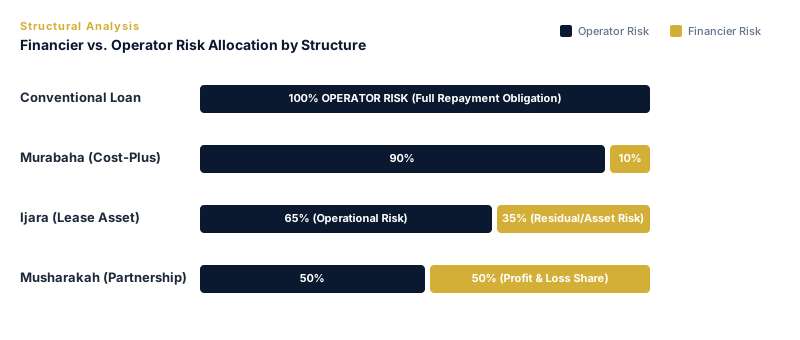
In a conventional loan, the operator bears construction, operational, market, and residual asset risks. The lender bears only the operator's overall credit risk.
The **Ijara** structure shifts the diagram materially. The financier owns the asset throughout the lease term and bears its residual value risk. If the asset becomes obsolete or suffers major impairment, the financier absorbs the consequence.
The **Istisna** structure shifts construction risk. The financier commissions the construction; if it overruns its budget or fails to complete, the financier rather than the operator carries the consequence until the asset is delivered to specification.
The **Musharakah** structure goes furthest. The financier shares in profits if the project performs and shares in losses if it does not, which resembles equity finance and attracts the highest pricing.
IV. When the Non-Interest Option Fits a Project
Five categories of Nigerian real-sector project benefit most from non-interest financing as a real economic option rather than a religious-compliance overlay:
"Sharia-compliant project finance does not abolish risk pricing; it relocates it from the cost of money to the structure of the asset."
1. Infrastructure Projects
Roads, airports, and public buildings benefit from the Istisna structure, which aligns with construction risk, funded through Sukuk capital market issuance.
2. Capital-Equipment Acquisitions
Specialised industrial plant and fleets with long economic lives fit the Ijara structure, shifting residual value risk to the financier.
3. Agricultural & Commodity Finance
Salam contracts and commodity Murabaha align with agricultural cycles and feedstock seasonality, avoiding calendar-driven debt repayment pressures.
4. Real Estate & Pre-Sales
Istisna-plus-Ijara structures align with developer and buyer pre-sale cash cycles, commonly used in Lagos developments.
Nigeria's non-interest financing market is growing rapidly: from ₦1.39 trillion in cumulative sovereign Sukuk by mid-2025, through Fitch's projected acceleration through 2026, to the planned $500 million international Sukuk.
The growth is being interpreted in much of the public conversation as a religious-finance story, when its substance is a project-finance story: a maturing market that allocates real economic risk through structures that align financier and operator more closely than conventional debt does in some categories of project.
Discuss Your Capital Architecture
Coinletter Advisory partners with real-sector sponsors to structure Sharia-compliant project finance. Whether evaluating Sukuk issuance potential or structuring lease-based equipment acquisitions, our team ensures risk-allocation and pricing match your operational realities.
Contact Our Advisory Team