Institutional Insight Paper
The Aggregation Problem: Why Agro-Processing Plants Underperform Their Financial Models
The upstream risk that lenders treat as a footnote
Executive Summary
The Feedstock Gap
Most Nigerian agro-processing facilities operate below their installed capacity for the same reason: they cannot reliably source the feedstock their financial model assumed. The aggregation problem, not the financing problem, determines the actual returns of agro-processing investments, and it determines them after the facility has been built, financed, and commissioned.
Post-harvest losses absorb between 30% and 50% of Nigerian agricultural output annually, costing the economy an estimated $9 to $10 billion. Yet the processor's exposure is more specific than aggregate spoilage: a fragmented smallholder base, variable quality, side-selling under contract, and a spot market that cannot deliver to specification on demand.
This paper examines the structural mechanics of feedstock supply for agro-processors in Nigeria, the systematic ways their financial models misprice this risk, and the engineering response that distinguishes operations that approach modelled capacity utilisation from those that do not.
Methodology and Scope
The analysis draws on Coinletter's engagements with agro-processing clients across grains, oilseeds, dairy, livestock, and horticulture, supplemented by publicly available data from the Central Bank of Nigeria, the Federal Ministry of Agriculture, the National Bureau of Statistics, and academic literature on the Anchor Borrowers Programme.
It focuses on medium-scale and large agro-processing facilities, where feedstock supply is industrial in nature and where investment-stage assumptions about supply are the primary source of post-completion underperformance. It does not address smallholder-level processing or cottage industries, where the economics are different in kind.
Conclusions apply most directly to crops with significant smallholder fragmentation, perishability, and quality variance: pepper, tomato, rice, cassava, oil palm, and feed-grain crops. The structural pattern observed is recurrent across these sectors, even where the specific mechanics of failure differ.
I. The Standard Financial Model and Where It Breaks
The financial model presented to a credit committee for a typical Nigerian agro-processing facility makes three structural assumptions about feedstock. First, that raw material will be available in the quantities the throughput calculations require. Second, that it will be available at prices in the range the cost-of-goods table projects. Third, that the quality and timing of supply will be consistent enough to keep the plant operating at the assumed capacity utilisation. These three assumptions are treated as parameters of the model, not as the project's primary risk.
In practice, they are the project's primary risk.
Once the facility is commissioned, the operator confronts a procurement reality that the model did not contemplate. Raw material exists in the country in absolute terms, but the supply that physically reaches the gate of a specific processor, at the quality specification its equipment requires, on the dates its production schedule depends on, and at prices that preserve the unit economics, is a different and far more constrained category.
Consider the throughput on which the financial model rests. A tomato paste line designed for 80,000 metric tonnes of fresh tomato annually assumes a defined harvest window, supplier reliability, and a post-harvest loss profile. National post-harvest loss data tells the story bluntly: tomato has a spoilage rate near 48%. A processor's actual purchasable tomato is roughly half of the gross national tomato available. The model that assumed national surplus implies abundance has misread the entire supply curve.
The pattern repeats across categories (pepper, rice, oil palm, fresh dairy), each with its own version of the same structural mismatch. Widening the procurement net to more middlemen increases volumes temporarily but degrades margins, as each layer adds cost and reduces quality and timing control.
By the time the facility produces below capacity in its second year, the letters of intent from aggregators have proved softer than suggested, and the institution discovers that what it underwrote was a manufacturing risk; what it actually owns is an aggregation risk.
II. The Three Layers of Aggregation Risk
The aggregation problem decomposes into three layers, each with its own mechanics and its own structural fix:
1. Fragmentation
The Nigerian smallholder base produces most of the primary agricultural output in plot sizes between 0.5 and 2 hectares. The processor needing 10,000 tonnes of pepper is buying from thousands of independent farms. This fragmentation introduces massive transactional margins and informational gaps.
2. Perishability & Quality Variance
Perishable horticulture experiences 40% to 60% losses before reaching market. Furthermore, quality variance is high: a rice mill calibrated for 14% moisture content cannot process paddy at 18% moisture without major yield loss. Quality risk is borne entirely by the processor at the factory gate.
3. Counterparty Discipline
Even with aggregators, the processor depends on farmers delivering on contracted terms. Side-selling is common: a processor pre-finances inputs, only for the farmer to sell to open spot markets at harvest when prices spike. The Central Bank's Anchor Borrowers Programme, which deployed over ₦1 trillion, encountered this pattern at scale.
Core Concept
Feedstock as Working Capital, Not Raw Material
The conventional accounting treatment of feedstock is as a raw-material input acquired through accounts payable. In Nigeria, feedstock behaves like working capital that must be pre-committed, pre-financed, and locked into supply contracts before processing begins, because spot markets cannot deliver to specification on demand.
Implication: Sizing the working capital requirement of an agro-processing facility must be done explicitly rather than treated as a residual operating budget line item.
III. The Anchor-Borrower Lesson
Nigeria's experience with the Anchor Borrowers Programme between 2015 and 2023 is the largest natural experiment in industrial-scale outgrower finance the country has conducted.
By 2018, the programme reported coverage of over 862,000 farmers across 835,000 hectares. Yield and productivity gains were real, but repayment rates were low. Farmers frequently diverted inputs or side-sold output when spot prices rose above the anchor's contracted price.
For the agro-processor designing an outgrower scheme today, outgrower credit only works under specific structural conditions:
- Strong cooperative organization: Social accountability structures that enforce delivery.
- Physical control of the harvest gate: Decentralised collection centres operated directly by the processor.
- Competitive harvest pricing: Structuring contracts to remain commercially attractive at harvest time.
- Differentiated input packages: Pre-paid inputs or custom seed varieties that are difficult to sell elsewhere.
IV. Engineering the Feedstock Pipeline
Designing for the aggregation problem at the project structuring stage is more efficient than discovering it after commissioning.
"The processor without an aggregation strategy is not building a business; she is renting a market."
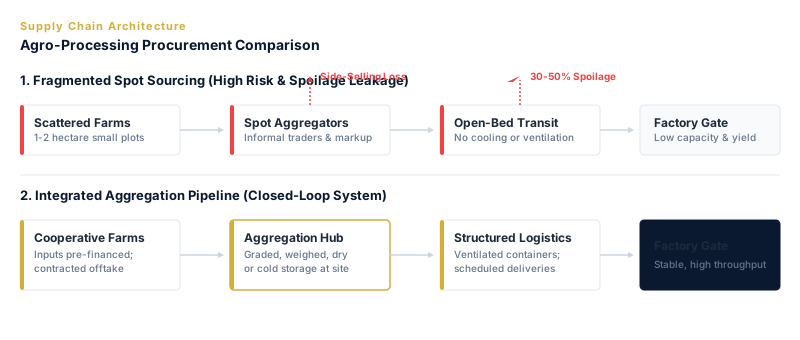
Four design choices distinguish operations that approach modelled capacity utilisation:
1. Primary Aggregation Ownership
Invest in the aggregation layer (collection centres, primary storage, cooperative networks) rather than capital-heavy farm ownership. This controls supply at a fraction of the cost.
2. Dedicated Supply-Chain Financing
Structure a separate financing tranche for the supply chain (RCFs or warehouse receipt finance) to fund harvest inventory peaks instead of relying on general cash reserves.
3. Multi-Source Supply Architecture
Diversify catchments across multiple states and independent aggregator networks, removing single points of failure from the production pipeline.
4. Mirroring Offtake Contracts
Structure downstream offtake commitments to match harvest seasonality and delivery variances, protecting the margin in both directions.
The constraint on agro-industrialisation is not access to plant capital; it is the absence of an aggregation layer between fragmented smallholders and processing facilities. Promoters must build the aggregation system first, or build it in parallel, but never assume it pre-exists.
Discuss Your Feedstock Architecture
Coinletter Advisory works with agro-processors and financiers to construct secure feedstock pipelines. From outgrower cooperative design to supply-chain working capital structuring, our advisory services ensure your plant runs consistently at modelled design capacity.
Contact Our Advisory Team