Institutional Insight Paper
The Disbursement Gap: Why Approved Facilities Don't Disburse
Why sanctioned capital stalls before it moves
Executive Summary
Sanctioned Capital
The disbursement gap is the structural distance between the day a development finance institution issues an approval letter and the day the borrower actually receives funds in its operating account. This gap, often spanning months and sometimes years, is the most expensive and least examined source of capital inefficiency in Nigerian real-sector finance.
The Bank of Industry disbursed a record ₦636 billion in 2025, the African Development Bank recently approved a $200 million facility to extend BOI's reach further, and Nigeria's annual development financing gap is estimated at over $35 billion. Yet the prevailing operator experience remains that approval is not capital, that capital arrives slowly, and that many approved facilities never disburse at all.
The gap is procedural rather than political, and it is engineered rather than negotiated. This paper sets out the mechanics behind the gap and the design choices that close it.
Methodology and Scope
The analysis draws on Coinletter's engagements structuring and reviewing development finance facilities for real-sector clients in agribusiness, manufacturing, and real estate, supplemented by publicly available data from the Central Bank of Nigeria, the Bank of Industry, the Development Bank of Nigeria, and African Development Bank disclosures.
It examines the post-approval phase of facility execution: the period between an approval letter being issued and the first effective drawdown. It does not cover the upstream phase (project structuring and credit appraisal), which is addressed elsewhere in this series. It also does not address Tier 2 commercial bank lending, where the dynamics are similar in form but operate on shorter timescales.
Conclusions apply most directly to asset-backed, naira-denominated real-sector facilities; offshore and trade-finance instruments behave differently and are noted only where they intersect.
I. The Two-Stage Lifecycle of a Facility
A facility is born twice in Nigerian development finance. The first birth is the approval, the moment a development finance institution's credit committee accepts the project and authorises its lending arm to extend funds, subject to conditions. The second birth is the drawdown, the moment those funds actually leave the institution's books and arrive in the borrower's operating account. The two events are commonly compressed into one in the operator's mental model: applied, approved, funded. They are in fact two distinct processes, separated by a stage of execution that most promoters experience as an unwelcome surprise.
Most operators arrive at the approval letter prepared to celebrate and ill-prepared to perform. The letter sets out a series of conditions to drawdown, which are pre-conditions the borrower must satisfy before any money moves. These conditions are not, in most cases, negotiable; they are derived from the institution's standing credit policy, from regulatory requirements supervised by the Central Bank of Nigeria under its 2015 Regulatory and Supervisory Guidelines for Development Finance Institutions, and from the specific terms negotiated during appraisal. They are also, almost always, more onerous and more dependent on third parties than the borrower expects.
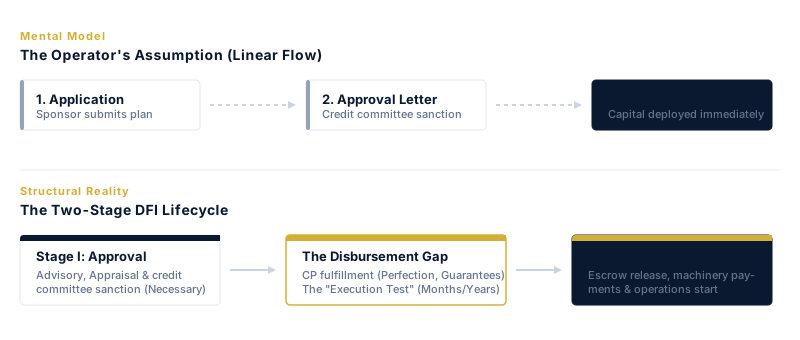
The institutional perspective on this stage is straightforward. Until conditions are satisfied, the borrower has been approved but has not earned the right to draw. The credit committee's mandate was to assess viability; the disbursement function's mandate is to confirm that the architecture supporting the loan is in place before exposing the institution's balance sheet. From the institution's side, this is good banking practice. From the borrower's side, it can feel like a second appraisal conducted after the appraisal supposedly concluded.
The asymmetry is structural. The borrower budgets for approval, secures internal commitments around the approval date, often signs supplier contracts and equity calls pointing at the approval as a fixed reference. The institution treats approval as the start of a sequence the borrower is now responsible for completing. Time passes. Costs escalate. The original assumptions that supported the credit appraisal become stale. In severe cases, the appraisal lapses entirely, and the facility must be re-presented to committee, sometimes on revised terms reflecting the changed environment.
This is the disbursement gap. It is rarely discussed in the public reporting of development finance, which prefers approval and disbursement figures aggregated annually, and it is rarely surfaced in case studies, which select for facilities that completed. Among the facilities that quietly never drew, or that drew much later than planned, lies a substantial portion of the most expensive misunderstanding in the sector: that an approval letter is capital.
The Bank of Industry's disbursement of ₦636 billion in 2025 is, in this light, a more impressive figure than it appears. It represents not just successful credit appraisals but successful execution through the gap, across more than 7,000 borrowers. The institutions are working; the procedural architecture is operating. The question this paper addresses is why so many promoters nevertheless find themselves on the wrong side of the gap, and what design choices distinguish those who clear it from those who do not.
II. The Conditions Precedent Cliff
If the disbursement gap has a precipice, it is the schedule of conditions precedent. The CPs, in development finance shorthand, are the documentary and procedural items the borrower must deliver before the institution will release funds. A typical Nigerian DFI facility lists between fifteen and thirty such conditions, ranging from the unremarkable (certified true copies of corporate documents, board resolutions, evidence of statutory compliance) to the genuinely demanding (security perfection across multiple registries, insurance policies assigned in favour of the lender, third-party guarantees, environmental and social impact certifications).
A borrower facing this list for the first time often misreads it. The list looks like paperwork. It is in fact a sequence of independent processes, each with its own gatekeepers, its own timelines, and its own opportunities to fail. The cliff metaphor is apt because the borrower's progress can run smoothly across twenty of the conditions only to stall indefinitely against the twenty-first. The drawdown depends on the slowest item, not the average pace of fulfilment.
Core Concept
The Conditions Precedent Cliff
The structural feature of Nigerian development finance facilities by which disbursement depends not on the average completion of post-approval conditions but on the slowest individual item among them. A facility with twenty-nine conditions met and one outstanding is, for drawdown purposes, no further along than a facility with one condition met and twenty-nine outstanding.
Implication: The disbursement timeline of any approved facility is set by the borrower's weakest execution capacity, not its average or strongest. Structuring engagements should identify the slowest CP at the appraisal stage, not after approval.
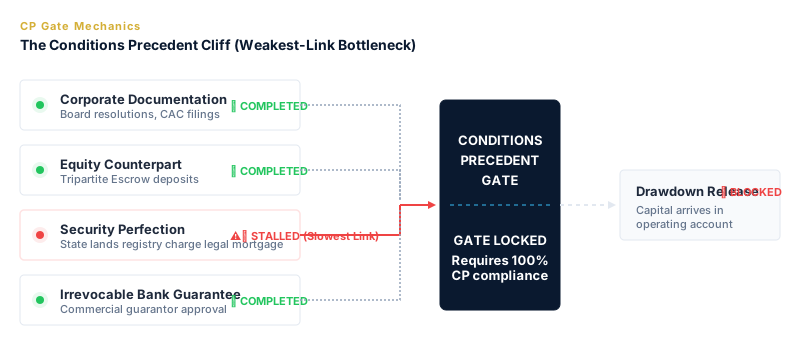
The conditions that most frequently produce stalls fall into three families:
1. Security Perfection
A facility secured on landed property, plant and equipment, or floating charges requires those interests to be formally registered with the relevant authorities, including the Corporate Affairs Commission for charges over company assets and the relevant state lands registry for legal mortgages. Perfection involves valuation, payment of stamp duties and registration fees, executed deeds, and processing time that varies between jurisdictions and the workload of the registry concerned. Lagos State perfection typically moves faster than perfection in jurisdictions with smaller bureaucracies; that observation alone changes how a facility should be structured for a multi-state operation.
2. The Bank Guarantee
Many DFI facilities require, as part of the security package, an irrevocable guarantee from a commercial bank acceptable to the institution. The borrower then approaches a commercial bank, which appraises the project independently, prices the guarantee, demands its own security package against the contingent exposure, and routes the decision through its own credit committee. In effect, the borrower must succeed at a second credit committee, often more sceptical than the first, to access the proceeds of the first.
3. Equity Contribution & Counterpart Funding
Most development finance facilities are partial finance: the institution lends a defined portion of the project cost, and the borrower must demonstrate that the balance is committed and available. Demonstration usually requires the equity to be deposited in a designated account or invested visibly in the project, before the loan disburses. Borrowers whose equity depends on asset sales, diaspora remittances, or staged investor contributions face a timing problem: the equity cannot be locked in until the loan is certain, and the loan will not disburse until the equity is locked in. The standard resolution is a tripartite escrow arrangement; the absence of one is a common cause of indefinite delay.
Beneath these three families sit a tail of smaller but cumulatively significant conditions: insurance assignments, environmental and social compliance, tax clearance from federal and state authorities, technical milestone evidence where the facility is staged against construction or production benchmarks, KYC refreshes, and post-approval changes to corporate documents arising from the loan itself. None of these are difficult in isolation; collectively they constitute a project management exercise the borrower has rarely been asked to perform before.
The institution, for its part, does not chase. It has limited capacity to do so, and the regulatory regime under CBN supervision discourages it from underwriting borrowers through their own administrative weaknesses. The borrower must execute, or the facility must be re-presented.
This produces an outcome that is statistically common and conceptually counterintuitive: approval is a necessary but radically insufficient condition for capital. The work of converting approval into capital is the borrower's own, and it is technical work, not commercial advocacy. The promoter who understood capital raising as a sales process is rarely prepared for the procedural execution that follows.
III. The Guarantor's Independent Appraisal
Of the three families of stalling conditions, the bank guarantee deserves separate treatment. Not because it is the most common cause of delay, though it frequently is, but because its mechanics expose a deeper structural feature of Nigerian development finance: the borrower must qualify for commercial credit at market rates to access development credit at concessionary ones.
The mechanism is direct. The DFI offers a concessionary rate, typically a single-digit annual interest charge with a moratorium structure that no commercial bank would entertain. To extend this rate, the DFI must in turn manage its own credit exposure. It does so by requiring the borrower to procure an irrevocable bank guarantee from a commercial bank, which assumes the credit risk in exchange for a fee. The DFI lends; the commercial bank stands behind the loan.
The economics for the commercial bank are unusual. The bank earns a guarantee fee, typically a percentage of the facility per annum, while assuming the full exposure if the borrower defaults. It earns none of the lending margin and yet carries the credit risk for the full tenor of the facility. Faced with this asymmetry, the commercial bank performs the same diligence it would perform for a direct loan, and often more rigorous diligence, because the upside is bounded by the fee while the downside is unbounded by the loss.
"The borrower must qualify for commercial credit at market rates to access development credit at concessionary ones."
This appraisal proceeds in parallel with the borrower's other CP work, sometimes sequentially, and is sensitive to two macroeconomic variables that have moved significantly in recent years. The first is the Central Bank of Nigeria's monetary policy rate, which the Monetary Policy Committee held at 26.5% at its May 2026 meeting. At this rate, the guarantor's opportunity cost of holding contingent exposure is high; the fee required to compensate that cost rises in step.
The second is the prime lending rate of commercial banks, which opened 2026 above 19%. The borrower who would have paid a one to two per cent guarantee fee in a lower-rate environment may now face three to five per cent, materially altering the effective cost of the underlying DFI facility.
This is the part of the structure that most surprises borrowers. They were attracted to development finance by the concessionary rate, completed an extensive appraisal to receive it, and now find that the all-in cost of accessing it is determined by a third party they had not budgeted for. The DFI's rate is real; the guarantee fee is a real addition; the security package required by the guarantor is a real demand on the borrower's collateral that may not have been factored into the original financing plan.
Beyond cost, the guarantor's appraisal can disqualify the facility outright. A commercial bank with a sector appetite that excludes the borrower's industry will decline the guarantee regardless of the DFI's appetite. A bank with concentration limits on the borrower's parent group will decline. A bank that views the project's cash-flow profile as inconsistent with its own collections schedule will decline. The borrower then must approach another bank, restart the appraisal, and absorb the time lost.
The institutional logic is coherent. The DFI is performing its development mandate by extending the rate; the commercial bank is performing its prudential function by gating the exposure to its own credit standards. The borrower, however, sits at the intersection of two different institutional logics with two different appetites, and must satisfy both to receive a single set of funds.
The implication for project structuring is significant. Identifying the likely guarantor early in the engagement, understanding that guarantor's sector appetite, collateral preferences, and pricing logic, and shaping the security package to match that guarantor's appetite rather than the DFI's checklist, is one of the highest-leverage activities in real-sector finance advisory work in Nigeria. The promoter who arrives at the guarantor's credit committee with a package already aligned to its credit policy is engineering for drawdown. The promoter who arrives with a package aligned only to the DFI's approval is hoping.
IV. Engineering for Drawdown: Three Key Design Moves
Closing the disbursement gap is a design problem more than a problem of effort. The borrower who treats CP fulfilment as a checklist to be worked through serially, after approval, will almost always experience delay. The borrower who treats CP fulfilment as a set of parallel processes to be initiated in concert, with each gating item identified at the appraisal stage, will close the gap by an order of magnitude.
"An approval letter judges the project; the disbursement process judges the borrower."
Three design moves matter most:
1. Engineered Security
A defensible security package is layered, with each layer addressing a defined risk to the lender and the guarantor (landed senior positions, plant/equipment assets cover, floating receivables charges, personal guarantees). Map this during project structuring, not after.
2. Early Guarantor Alignment
Identify and partner with the commercial bank guarantor before approaching the DFI. Aligning the security package to the guarantor's specific sector limits and credit policy early saves months of post-approval friction.
3. Escrowed Equity
Escrow equity and counterpart funding contributions early. Establishing escrow structures during appraisal demonstrates committed capital to the credit committee and prevents delay when approval lands.
Beneath these three is a set of smaller execution disciplines: the borrower's CP project plan begins on the day the appraisal begins, not the day the approval letter arrives; the borrower's professional team (lawyers, valuers, insurance brokers) is engaged before the CP list is issued, not after; the borrower's CP tracker is updated weekly and shared with the institution's relationship manager, who appreciates the visibility and accelerates response where authorised.
None of these are advisory pyrotechnics. They are project management applied to the procedural reality of how Nigerian development finance institutions actually disburse. The reason they create disproportionate value is that most promoters do not apply them. The disbursement gap exists, in large part, because the borrower's planning energy concentrates at the appraisal stage, when in fact the appraisal stage is the easier of the two stages to traverse. Approval is a credit decision; disbursement is an execution test.
For the institutional reader, the policy implication is also significant. A development finance system measured primarily by approvals overstates its developmental effect, because approvals that do not disburse do not deploy capital. A system measured by disbursements understates the unmet demand, because facilities that lapse before drawdown disappear from the statistics. The disbursement gap is a feature of the data as well as a feature of the experience.
For the promoter, the conclusion is more practical. The work that ends at the approval letter has, in most cases, only just begun. The work that ends at the first drawdown is the work that earns the rate.
Discuss Your Facility Architecture
Coinletter Advisory partners with institutional investors, project sponsors, and development finance institutions to bridge the disbursement gap. Whether structuring a new project security package or facilitating guarantor alignment, our team ensures your sanctioned capital translates to active, operational cash.
Contact Our Advisory Team