Institutional Insight Paper
Why Agribusiness Projects Fail Structurally in Nigeria
A Value-Chain Engineering Perspective
Executive Summary
The Capital Paradox
Nigeria’s agribusiness sector is increasingly characterized by a capital paradox. Institutional interest in the real sector has grown—driven by food security concerns, inflation-hedging strategies, and government incentives aimed at strengthening domestic production—yet the attrition rate of large agribusiness projects remains unusually high.
Various industry and policy estimates suggest that Nigeria incurs between ₦3.5 trillion and ₦5 trillion annually in economic losses due to post-harvest inefficiencies alone, reflecting 30–40 million metric tonnes of food lost after harvest across key value chains. These losses persist despite expanding investment flows into processing facilities, integrated farms, and agricultural value-addition ventures.
Conventional explanations for project failure often emphasize macroeconomic volatility, infrastructure constraints, or limited access to finance. While these factors matter, they frequently represent symptoms rather than root causes. This paper argues that many agribusiness projects fail because of structural misalignment between capital investment and the operational architecture of the value chain. In many cases, projects appear bankable on paper but remain operationally unprepared for the scale and structure of capital they seek.
Two recurring structural conditions contribute significantly to this outcome:
- The Energy–Margin Collision, where high and volatile energy costs interact with naturally thin early stage operating margins.
- The Capital Absorption Gap, where value chains lack the operational capacity to productively deploy large investments, leaving capital stranded in under utilised assets.
In response, this paper introduces Value Chain Engineering as a disciplined alternative to traditional business planning and proposes the Value Chain Engineering Blueprint (VCEB™) as a framework for evaluating project readiness before significant capital is deployed. The analysis focuses on Nigeria but reflects patterns observable across many emerging market agribusiness systems.
Methodology and Scope
This paper synthesises market observations, public industry data, and structural analysis of agribusiness projects across Nigeria’s processing and aggregation sectors. While the discussion focuses primarily on Nigeria, many of the structural dynamics described—such as fragmented supply chains, energy volatility, imported equipment dependency, and capital absorption constraints—are common across emerging market agro industrial ecosystems.
The analysis draws on examples from subsectors including rice milling, poultry feed and processing, grains and flour, and tomato and horticulture processing. These are segments where large investments have attempted to translate farm level production into industrial value chains, with mixed outcomes.
I. The Anatomy of Failure: Beyond the "Potential" Narrative
For decades, the investment narrative around Nigerian agriculture has emphasised arable potential—vast land availability, favourable agro ecological zones, and strong domestic demand for food. However, in capital intensive agro industrial ventures, soil is merely a raw material; it is not a business model.
The transition from farm gate production to an industrial agribusiness enterprise requires a carefully engineered system integrating: production, logistics, storage, processing, energy supply, and distribution channels. Many projects fail because this system is never designed coherently before capital is deployed. Instead, sponsors frequently retrofit operational assumptions around predetermined capital expenditure envelopes rather than designing the value chain from throughput requirements backward.
In practice, this means capacity decisions (e.g., a 10 ton per hour mill) are often made before there is a validated strategy for securing consistent, grade compliant supply, affordable and reliable power, or bankable offtake. The result is that capital funds an ambition rather than an engineered system.
1. The Energy–Margin Collision
Energy has become a structural variable in Nigerian agro processing economics rather than merely an operating line item. Diesel based power in rural and peri urban contexts can cost upwards of ₦150 per kWh, and high fuel prices have been known to consume a substantial share of farm and processing profits.
For many integrated agribusiness operations, energy expenses can account for roughly 20–40 percent of total production costs, particularly where facilities rely heavily on diesel generation or unstable grid supply supplemented by generators. This cost structure creates a latent vulnerability during the early ramp up phase of projects.
Core Concept
Energy–Margin Collision
The compounding point of failure where high, volatile energy costs interact with naturally thin early-stage operating margins.
Implication: Projects without a structural energy strategy often exhaust working capital prematurely before reaching optimal capacity utilisation.
Early Stage Margin Compression
During the commissioning and ramp up phase—typically the first three years—projects operate below optimal scale while supply chains stabilise and operational systems mature. Margins are naturally thin due to incomplete capacity utilisation, learning curve inefficiencies, and commissioning losses. When these fragile margins are forced to absorb volatile energy costs, the project’s cost structure can quickly become unstable.
Throughput Feedback Effects
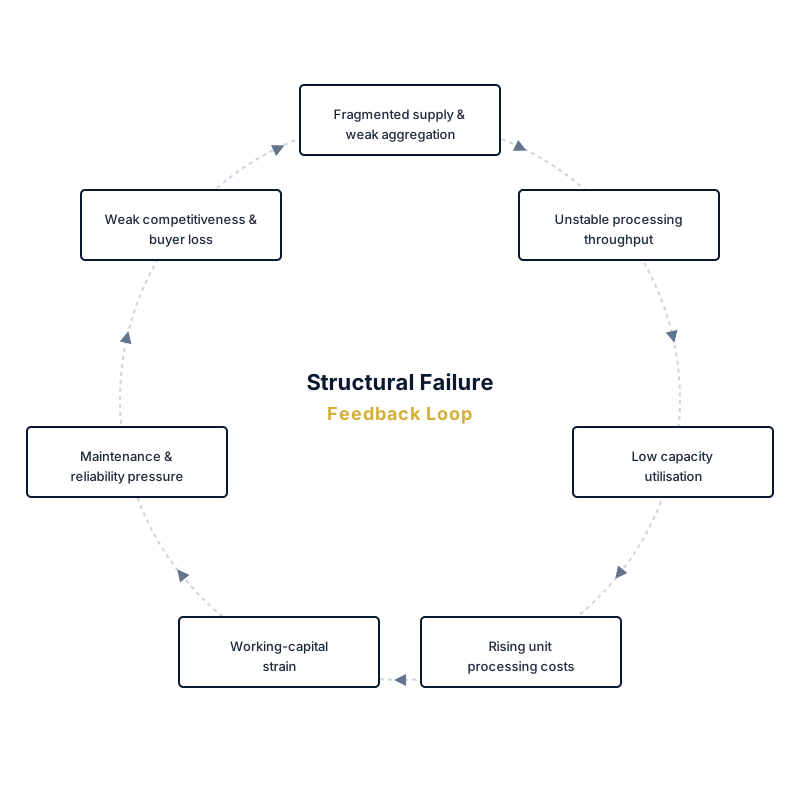
To conserve cash, processors often respond to energy shocks by reducing operating hours or throughput. However, lower throughput spreads fixed and quasi fixed costs—energy infrastructure, key staffing, maintenance—over fewer units of output, further compressing margins.
For example, a mid scale rice mill operating at 35–40 percent of installed capacity under diesel backed power may quickly find its unit processing costs approaching or exceeding import parity levels for milled rice, even before financing costs are fully reflected. This can trigger a negative feedback loop: declining throughput drives up unit costs, weakening competitiveness, which in turn further reduces volumes as buyers switch to cheaper alternatives or imports.
2. Imported Hardware and Technical Dependency
Nigeria’s agro industrial ecosystem also relies heavily on imported processing equipment. While such machinery can deliver high levels of efficiency and product quality, it introduces two structural vulnerabilities when embedded in underdeveloped support ecosystems.
Foreign Exchange Exposure
Currency volatility significantly affects both the replacement cost of machinery and debt servicing for foreign denominated equipment loans. Recent episodes where the naira has traded between roughly ₦1,400 and ₦1,700 per US dollar materially increase the naira cost of maintaining and refinancing imported industrial equipment. Projects that appeared viable at earlier exchange rates can quickly see their maintenance and debt service burdens outpace cash generation.
Maintenance and Technical Support Gaps
Specialised machinery often requires technical expertise and spare parts logistics that remain limited locally. When critical components fail, repairs may depend on imported parts or international technicians. In seasonal processing industries—such as tomato, grains, or oilseeds—downtime of several weeks can mean the loss of an entire harvest cycle’s revenue, in addition to reputational damage with farmers who cannot evacuate produce on time.
These dependencies convert technical failures into compounded financial risks. Unplanned shutdowns during harvest windows reduce throughput, increase effective unit costs, and can trigger working capital squeezes as inventory and receivables cycles are disrupted.
II. The Capital Disconnect: Bankability vs. Operational Readiness
"What appears to be a financing problem is often an architecture problem."
In Nigeria’s agribusiness landscape, many projects do not fail for lack of capital. They fail because capital arrives into systems that are not structurally ready to use it productively. From the sponsor’s perspective, this often appears as a financing problem; from the system’s perspective, it is fundamentally an architecture problem.
A project can present strong projected returns, credible demand, and persuasive narratives yet still be unable to convert capital inflows into stable throughput and predictable cash flows. The distinction between bankability and operational readiness is therefore critical. Bankability is typically evaluated through financial projections, collateral structures, and macroeconomic assumptions. Operational readiness, however, depends on more practical conditions: the reliability of raw material supply, the coherence of logistics and aggregation, achievable process yields, availability of working capital, and the resilience of the cost structure to shocks.
When these operational conditions remain underdeveloped, capital deployment tends to amplify fragility instead of strengthening the system. What appears to be under financing at the proposal stage often reveals itself, in practice, as a misalignment between investment size and the true carrying capacity of the value chain.
1. Informal Supply Chain Instability
A recurring failure pattern involves building large processing capacity on top of informal, weakly coordinated supply systems. Sponsors frequently assume that raw materials can be aggregated from surrounding farmers as needed. In reality, fragmented procurement introduces hidden costs and volatility that are rarely captured in financial models.
One of the most significant of these hidden costs is the Standardisation Cost—the margin erosion that arises from inconsistent quality, moisture levels, and grading standards. Processors must invest in sorting, drying, cleaning, and rejecting non compliant inputs. In some milling and oilseed systems, these adjustments can compress gross margins by low double digit percentages once real input variability is accounted for.
Informal market dynamics also drive supply fragmentation. Traders offering immediate cash at farm gate can divert volumes away from structured processors, particularly during seasonal price spikes. Facilities designed to operate at 70–80 percent utilisation may instead oscillate between 30–50 percent utilisation across the year. Sector assessments in rice and flour milling have repeatedly highlighted such under utilisation, driven in part by inconsistent access to grade compliant paddy and grains rather than by demand constraints alone.
In the absence of organised aggregation systems—such as contracted outgrower programmes, embedded extension services, and strategically located collection centres—processors are forced into opportunistic buying. Over time, this erodes throughput stability, undermines quality control, and weakens financier confidence in the project’s ability to meet its cash flow obligations.
2. The Capital Absorption Gap
Core Concept
Capital Absorption Gap
The structural distance between the level of installed investment capital and the operational maturity of the surrounding value chain required to support it.
Implication: Large initial investments trap capital in fixed assets while throughput remains chronically low due to supply constraints, driving up unit economics.
In many projects, large investments are deployed upfront into land, buildings, and high capacity machinery, while critical supporting components—structured procurement arrangements, storage and handling infrastructure, working capital facilities, downstream offtake agreements, and maintenance capabilities—develop far more slowly. Capital becomes trapped in fixed assets that operate well below design capacity or cycle on and off as supply, energy, and technical constraints bite. For investors, this manifests as persistent underperformance relative to projections, recurring restructuring discussions, and, in some cases, eventual asset impairment.
From an operational perspective, a 10 ton per hour plant that rarely sees more than 3–4 tons per hour of consistent, grade compliant input is not simply underutilised; it is structurally misaligned. Unit processing costs rise, maintenance and overhead are spread over fewer tonnes, and working capital cycles become more volatile. When this is compounded by FX linked equipment costs, volatile energy prices, and fragmented downstream distribution, even modest deviations from the ramp up curve embedded in the model can push the project toward distress.
Case Study
Illustrative Scenario: A Midstream Rice Processor in Northern Nigeria
Consider an anonymised example of a mid scale rice processing project in northern Nigeria. The sponsor raises a mix of concessional debt and equity to establish a 120 ton per day integrated rice mill, justified by strong domestic demand and supportive policy rhetoric around rice self sufficiency. The financial model assumes that local paddy supply will rapidly fill the mill, with utilisation increasing from 40 percent in Year 1 to 80 percent by Year 3.
Construction is completed broadly on schedule, and the plant is commissioned. However, the upstream architecture remains largely informal: there are no binding supply contracts, limited aggregation infrastructure, and no structured outgrower scheme. Farmers sell paddy to whichever buyer offers the best cash terms at harvest, often informal traders moving grain across state lines or into alternative markets. As a result, the mill secures only 30–40 percent of its expected monthly paddy volume, with highly variable grain quality and moisture content.
To conserve cash, management reduces operating shifts and runs the plant intermittently. This decision inadvertently triggers the Energy–Margin Collision: lower throughput spreads energy and staffing costs over fewer tonnes, pushing unit processing costs above levels that the business model can sustain. At the same time, spikes in diesel prices and depreciation of the naira increase both energy expenditure and the cost of imported spare parts. Occasional mechanical failures lead to extended shutdowns while critical components and technicians are sourced internationally.
A proposition that appeared highly bankable at approval has evolved into a textbook case of a severe Capital Absorption Gap: the surrounding value chain was never engineered to support the scale and structure of capital deployed.
"Capital does not, by itself, create capability."
III. The VCEB™ Framework: A Structural Diagnostic Approach
In response to these recurring structural failures, Coinletter Advisory developed the Value Chain Engineering Blueprint (VCEB™). VCEB™ is a structured diagnostic framework designed to evaluate whether a project’s value chain is coherent, capable of absorbing capital, and disciplined in its deployment of funding before and after investment decisions are made.
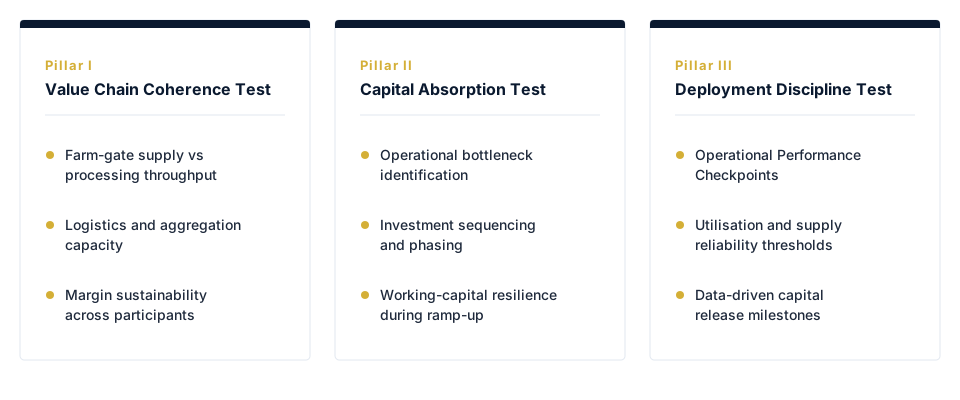
Rather than focusing primarily on financial projections, VCEB™ assesses the structural compatibility between capital and operations across three pillars:
Value-Chain Engineering Blueprint (VCEB™)
Pillar I: Value Chain Coherence Test
The Value Chain Coherence Test examines whether the operational flow of the project functions as a balanced system from farm gate to end market. Key questions include:
- Does farm gate production capacity match processing throughput, within defined tolerance bands?
- Are logistics and aggregation systems capable of supporting projected supply volumes with acceptable variability?
- Is value distributed across the chain in a way that allows all participants—farmers, aggregators, processors, and distributors—to remain economically viable?
When margin distribution is too skewed toward the processor, upstream actors rationally default to informal market channels that pay faster or more, regardless of long term commitments. Conversely, when processors carry an unsustainable share of risk and cost, under investment in maintenance and working capital becomes likely, weakening system reliability.
The coherence test formalises these dynamics into measurable indicators such as capacity matching ratios, acceptable variance in daily supply volumes, and target levels of process loss and rework.
Pillar II: Capital Absorption Test
The Capital Absorption Test evaluates whether the value chain can productively deploy the quantum and structure of capital being requested. It focuses on:
- Identifying operational bottlenecks that would prevent scale up (e.g., storage constraints, seasonal road inaccessibility, maintenance capacity).
- Determining appropriate investment sequencing, including where smaller initial capacity and modular expansion are preferable to immediate large scale build out.
- Evaluating working capital requirements and cash cycle resilience during ramp up.
In many cases, VCEB™ recommends phased capital deployment: using modest initial capacity to validate supply reliability, process yields, and market response before adding additional lines or expanding geographic reach. For example, investments in high capacity processing equipment may be deliberately delayed until supply contracts, storage infrastructure, and logistics performance meet predefined readiness thresholds.
Pillar III: Deployment Discipline Test
The Deployment Discipline Test replaces purely time based or construction milestone funding schedules with Operational Performance Checkpoints (OPCs). Instead of releasing capital according to calendar dates or completion certificates alone, funding tranches are linked to verifiable system readiness indicators.
Core Concept
Operational Performance Checkpoints (OPCs)
Funding criteria based on demonstrable system performance rather than calendar dates or construction completion.
Implication: Prevents capital from flowing into capacity expansions before the underlying supply, energy, and maintenance architecture is proven to handle existing scale.
Examples of OPCs include:
- Achieving a minimum of 70–75 percent utilisation over three consecutive months at defined quality and yield parameters.
- Demonstrating supply chain reliability thresholds (e.g., a target share of input volume under contract versus spot purchases).
- Maintaining process losses and rework rates below specified benchmarks over a defined production volume.
This approach disciplines both sponsors and financiers. It aligns capital deployment with actual operational capability, reduces the risk of funding unready capacity expansions, and creates a shared, data driven language for assessing progress.
IV. The Stabilising Processing Hub Model
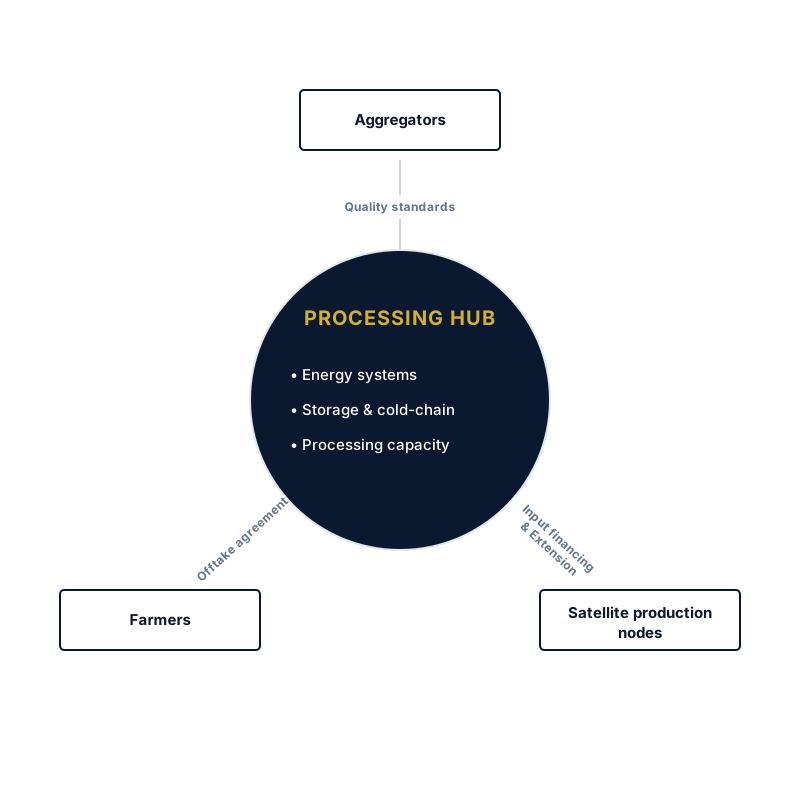
To address supply fragmentation and energy volatility, Coinletter advocates an inward out processing hub architecture as a practical expression of value chain engineering. In this model, the processing facility operates as the stabilising centre of the value chain rather than as a passive taker of whatever the surrounding system offers.
Inward Stabilisation
The hub concentrates key infrastructure investments at a single, controllable node, including:
- Modular, more predictable energy systems (e.g., renewables backed mini grids or hybrid systems).
- Cold chain and dry storage assets positioned to reduce post harvest losses.
- High efficiency processing technologies designed for maintainability and local service support where possible.
By stabilising energy supply and reducing post harvest losses at the core of the system, the hub structurally improves value chain efficiency and mitigates the Energy–Margin Collision.
Outward Standardisation
From this stable core, the hub extends standardisation outward through structured supplier relationships. Independent farmers and aggregators become satellite production nodes connected to the hub through clear procurement frameworks and quality protocols. Tools such as simple grading guidelines, digital procurement platforms, and standard contract templates help translate technical requirements into practical rules of engagement.
Contractual Supply Architecture
Rather than relying on opportunistic spot procurement, the hub coordinates supplier participation through structured agreements that may include:
- Guaranteed or preferential offtake arrangements within defined quality and volume bands.
- Input financing or input on credit models linked to offtake.
- Embedded technical extension support to improve yields and quality.
- Enforced quality and delivery standards, with transparent incentives and penalties.
When designed thoughtfully, these arrangements embed risk sharing mechanisms—such as price bands or indexed pricing—that align farmer and processor economics. The result is a more stable and predictable industrial supply system that supports higher utilisation, better cost control, and more bankable cash flow profiles.
V. Regional Leverage: AfCFTA and Export Optionality
Many agribusiness projects in Nigeria are designed solely around domestic markets, leaving them highly exposed to fluctuations in local purchasing power, regulatory shifts, and currency volatility. Regional trade frameworks now offer alternative pathways that can be designed into projects from the outset.
The African Continental Free Trade Area (AfCFTA) and the Pan African Payment and Settlement System (PAPSS) are gradually lowering frictions for intra African trade and payments. Policy developments in Nigeria have begun to streamline documentation and compliance for PAPSS enabled transactions, particularly for SMEs. For well structured agrifood projects, this opens opportunities to diversify demand across markets and, in some cases, access stronger or more stable currency earnings.
Projects designed with export readiness—even if they initially sell predominantly into the domestic market—gain several structural advantages:
- Access to diversified demand across regional markets, reducing dependence on any single national demand cycle.
- Improved revenue resilience during domestic macroeconomic shocks or policy changes.
- Stronger credit and valuation profiles for institutional investors who value diversified revenue and currency exposure.
Practically, export readiness implies building in quality, traceability, and logistics capabilities consistent with regional standards, as well as considering cross border routes, compliance requirements, and payment channels at the design stage rather than as an afterthought.
VI. From Planning to Engineering: Implications for Stakeholders
Nigeria’s agribusiness challenge is not primarily one of land availability or even headline capital scarcity. It is a challenge of system design. Many projects continue to rely on traditional business plans that emphasise financial projections while overlooking structural constraints and feedback loops within the operational system.
Moving from agricultural potential to agro industrial performance requires a shift from planning to engineering. For key stakeholders, this implies:
Project Sponsors
Designing value chains that can support industrial throughput before pursuing large capital injections, and embracing phased, evidence based scaling.
Capital Providers
Complementing credit analysis with structural diagnostics, asking how value chains will absorb and sustain the capital requested, not just whether projected returns look attractive.
Policy Makers & Ecosystem Builders
Focusing interventions on enabling coherent value chain architectures—energy reliability, aggregation infrastructure, technical support ecosystems—rather than on isolated asset creation.
Advisory Community
Moving beyond narrative driven business planning towards structured value chain diagnostics such as VCEB™, and embedding Operational Performance Checkpoints into financing structures.
Agribusiness in emerging markets seldom fails because of insufficient resources alone. More often, it fails because the system was never engineered to sustain scale. Value Chain Engineering offers a practical framework for confronting that reality—aligning capital with capability, and shifting the conversation from “How much funding can we raise?” to “What level and structure of capital can this value chain responsibly absorb?”
Discuss Your Value Chain Architecture
Coinletter Advisory partners with institutional investors, project sponsors, and development finance institutions to conduct structural diagnostics of agribusiness projects. Whether evaluating a new investment case or restructuring an existing asset, our Value Chain Engineering Blueprint (VCEB™) provides the clarity needed to align capital with operational capability.
Contact Our Advisory Team